
Executive Summary
Pronoun choices (“we,” “you,” and “I”), levels of formality, and language selection in university communications measurably shape brand sentiment. The right approach depends on the audience’s familiarity with the brand, cultural background, and linguistic identity.
Every piece of communication your institution sends, whether an admissions email, alumni newsletter, social media post, or donor appeal, shapes how students perceive your level of care. Research shows that even small linguistic choices, like pronoun selection, can measurably shift how people perceive your brand.
In other words: deliberate language choices in institutional communications strengthen brand sentiment, deepen engagement, and build lasting loyalty among students, alumni, parents, and donors.
“We,” “You,” and the Question of Fit
Sela, Wheeler, and Sarial-Abi (2012) ran four experiments examining how closeness-implying pronouns like “we” affect consumer attitudes toward brands. They found that “we” can produce either positive or negative reactions depending on whether the implied closeness matches the audience’s actual relationship with the brand. When the closeness feels earned, “we” strengthens positive sentiment. When it feels presumptuous, it backfires.
This finding carries significant implications for universities. A first-year student who has barely arrived on campus may respond differently to “we” language than a ten-year alumnus who attended every homecoming. An admissions brochure that says “Together, we will shape your future” might resonate with an admitted student who has already committed. That same phrase could feel overly familiar to a prospective student still weighing options. Administrators should calibrate pronoun use to the audience’s stage in their relationship with the institution.
The Power of “You”
A different study from 2017 demonstrated that second-person pronouns (“you”) increase consumer involvement and positive brand attitudes. The mechanism behind this effect is self-referencing: when people encounter “you” in a message, they naturally project themselves in the picture, which helps with building a more relatable image.
Applied to university communication, consider the difference between “Students gain access to world-class research facilities” and “You will have access to world-class research facilities.” The second version invites readers to picture themselves in the scenario, and feels more natural/personalized without changing the content itself.
The researchers also found that this effect held especially strongly for people with more individualistic tendencies. These are people who think of themselves primarily as individuals rather than as members of a group. Whenever you are crafting marketing messages, consider the audience: do the students you are targeting more collectivist or individualist? This perception will be strongly influenced by the student’s goals and cultural background (we will cover cultural nuances in a bit more detail later in the article).
When Staff Say “I,” People Feel Heard
Packard, Moore, and McFerran (2018) studied customer-firm interactions and found that employees who use first-person singular pronouns (“I” rather than “we” or passive constructions) generate higher customer satisfaction. “I” language signals personal investment and empathy and makes the speaker seem individually accountable and genuinely engaged. It also helps resolve potential conflicts by avoiding finger-pointing or the perception of “passing the blame”.
This research applies directly to university staff. Financial aid counselors, admissions officers, residence life coordinators, and academic advisors all interact with students and families during high-stakes moments. An admissions officer who writes “I reviewed your application and wanted to share some thoughts” creates a more human connection than one who writes “Your application has been reviewed.”. Training front-line staff to use “I” language in emails, phone calls, and in-person interactions strengthens the perception that your institution cares about each person as an individual.
There is another element to this that was not as relevant during the original 2018 research, but plays a major role in 2026: “I” signals a human interaction in an age of AI. Disclosing a chatbot’s AI identity before a conversation reduced purchase rates by more than 79% (Luo et al. 2019). Customers perceived the disclosed bot as less knowledgeable and less empathetic, even when the bot performed at the same level as a skilled human worker. The power of “I” persist even if there was no human on the other end of the line: chatbots using first-person singular pronouns and signaling a personal identity increased user likeability and social presence (Adam, Wessel, and Benlian 2021). Administrators (human or robot) who communicate with personal pronouns give their institution a tangible way to stand apart from the impersonal interactions students encounter elsewhere.
Cultural Nuances In Pronoun Use and Perception
Researchers developed and tested the pronoun strategies above largely in Western, individualistic contexts. Universities with international student populations, or those recruiting globally, must account for cultural variation in how people interpret language.
Hofstede’s Cultural Dimensions Framework
Geert Hofstede’s cultural dimensions framework offers the most widely used lens for understanding these differences.
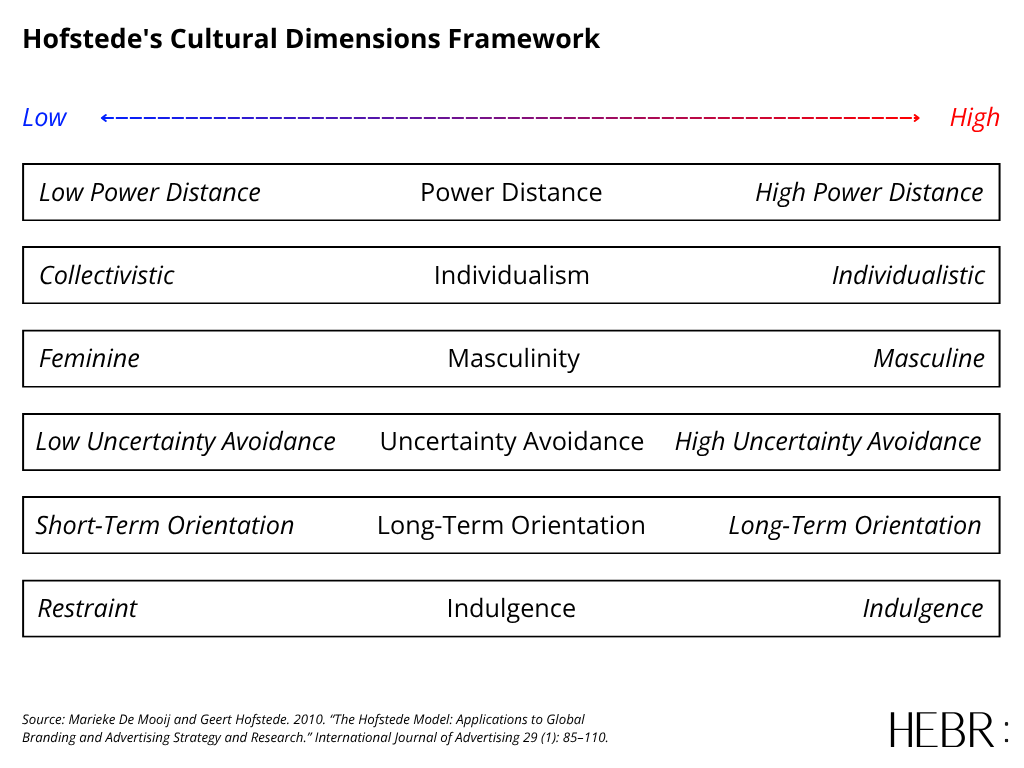
Two dimensions matter most here: individualism versus collectivism, and power distance.
In individualistic cultures, people define themselves through personal traits, goals, and achievements. In collectivistic cultures, people define themselves through their relationships and group memberships, placing a high value on loyalty, cooperation, and maintaining social cohesion.
| Individualistic cultures | Collectivistic cultures | |
| Characteristics | Emphasize personal identity and self-expression | Prioritize group harmony, loyalty, and shared identity |
| Examples | United States, Australia, Scandinavian countries | Japan, China, South Korea |
Power distance refers to the degree to which less powerful members of a society accept and expect that power is distributed unequally. In other words, it measures how a culture handles inequalities in status, authority, and influence.
| Low power distance cultures | High power distance cultures | |
| Characteristics | Strong hierarchical order in personal and professional contexts | Flatter power structures, questioning authority is common |
| Examples | Japan, Germany | Sweden, Finland, Denmark |
These dimensions directly affect how people respond to institutional language. People in individualistic cultures tend to be “I”-conscious and favor explicit, direct verbal communication. People in collectivistic cultures tend to be “we”-conscious and root their identity in the social group. The same “you”-centered language that Cruz, Leonhardt, and Pezzuti found effective for boosting involvement may land differently with a student from Tokyo than with a student from Stockholm. Students from collectivistic backgrounds may respond more positively to messaging that emphasizes group belonging, family pride, or community contribution than to messaging that spotlights individual achievement.
Kashima and Kashima (1998) provided further evidence for this link between culture and pronoun use. They examined 39 languages across 71 cultures and found that cultures whose languages allow speakers to drop pronouns (a feature common in Japanese, Korean, and many other East Asian languages) tended to score lower on individualism. Language structure itself, they argued, reflects and reinforces how a culture conceives of the relationship between self and group. Pronoun-heavy, direct-address messaging may feel natural and engaging to audiences from non-pronoun-drop language backgrounds like English, German, and French. That same messaging may feel blunt or even intrusive to audiences from pronoun-drop language backgrounds.
Edward T. Hall’s (1976) distinction between high-context and low-context communication cultures adds another practical layer. In low-context cultures (the United States, Scandinavia, Germany), people expect words to carry meaning explicitly: there is less need for “room temperature readings”. On the other hand, in high-context cultures (Japan, China, Arab nations), much of the meaning lives in situational cues, shared understanding, and what remains unsaid. A university email that states “You have been selected for this honor because of your outstanding academic record” works well in a low-context environment. Directness signals respect there. In a high-context environment, that same directness might feel unnecessary or even rude depending on the situation. The recipient would expect to infer the reasoning from the context of receiving the communication itself.
Power distance creates another fault line. In high power distance cultures, institutional communication carries weight partly because of the institution’s authority, and audiences expect a degree of formality that signals respect for that hierarchy. A casual, first-name-basis tone that works in a Swedish or Finnish university’s emails could feel disrespectful to a student or parent from a culture where academic institutions hold significant social authority. The reverse also applies. Overly formal communications aimed at audiences from low power distance cultures (Scandinavian countries, the Netherlands) can feel stiff and alienating. Power distance shapes expectations around styles of address, levels of formality, and the acceptability of direct communication between people at different levels of a hierarchy.
Universities competing for international students need a segmented approach to brand language. A single tone, a single pronoun strategy, and a single level of formality will resonate with some audiences while alienating others. Institutions that recruit heavily from East Asia may benefit from communications that emphasize collective achievement, institutional prestige, and family-oriented outcomes, all delivered in a tone that respects hierarchical expectations. Communications aimed at Northern European markets can lean into the direct, egalitarian, “you”-centered approach that the pronoun research supports.
How Bilinguals Navigate Between Cultural Frames
The cultural segmentation described above assumes that each student belongs to one cultural context. Many international students, however, operate in two or more. Bilingual individuals shift between entire cultural frameworks depending on the language they use at a given moment (Luna, Ringberg, and Peracchio 2008). Bicultural bilingual individuals activate distinct sets of culture-specific mental frames when cued by a particular language: aspects of identity, values, and self-perception. Critically, this frame switching occurred only in participants who had genuinely incorporated both cultures into their lives: for bilinguals who identified with only one culture, language itself acted as the trigger for cultural signals.
Another study from 2006 documented a parallel finding in the domain of personality: across three studies of Spanish-English bilinguals in the United States and Mexico, they found that participants scored higher on extraversion, agreeableness, and conscientiousness when responding in English than when responding in Spanish (Ramírez-Esparza, et al. 2006). Language did not only change how participants expressed themselves, as well as how they perceived and described who they were.
For universities, these findings carry practical weight. A Chinese-English bilingual student reading an English-language admissions email may process it through a more individualistic, Western cultural frame. That same student reading a Chinese-language version of similar content may process it through a more collectivistic frame, prioritizing family expectations and group identity. The language of the communication primes which cultural self responds to the message.
This creates both an opportunity and a risk. Universities that communicate with bilingual prospects in their heritage language can tap into cultural values like family obligation, collective pride, and respect for institutional authority. Those that communicate only in English may inadvertently activate a more individualistic frame that competes with the family-centered decision-making process many international students actually use when choosing a university. Administrators should recognize that for bilingual audiences, language choice is itself a form of cultural positioning. The language you write in shapes which version of the reader engages with your message.
Putting These Insights Into Practice
The ‘right’ way to address your students will heavily depend on context, audience, and culture. Below are a few practical guidelines that can help you determine which words to choose:
- Reserve “we” language for audiences who already feel connected to the institution: current students, active alumni, and long-standing donors. Using “we” with these groups reinforces shared identity and belonging.
- Lead with “you” in outward-facing and recruitment-oriented communications aimed at audiences from individualistic, low-context cultural backgrounds. Direct address draws these readers in and makes institutional benefits feel personal.
- Encourage staff to use “I” in one-on-one interactions, as it strengthens personalization and trust signals, and makes people feel seen.
- Segment international communications by cultural context. Audiences from collectivistic or high power distance cultures respond more favorably to language that emphasizes group belonging, institutional authority, and appropriate formality.
University brand sentiment forms over years, through thousands of individual interactions and communications. Each of those moments offers a chance to strengthen or weaken the relationship between your institution and the people it serves. Language is one of the most accessible and cost-effective levers administrators have for building positive sentiment. The words are already there. The task is choosing them with intention, calibrated to the cultural context of the people reading them.
Sources
Adam, Michael, Malte Wessel, and Alexander Benlian. 2021. “AI-Based Chatbots in Customer Service and Their Effects on User Compliance.” Electronic Markets 31 (2): 427–445.
Cruz, Raphael E., James M. Leonhardt, and Todd Pezzuti. 2017. “Second Person Pronouns Enhance Consumer Involvement and Brand Attitude.” Journal of Interactive Marketing 39: 104–116.
De Mooij, Marieke, and Geert Hofstede. 2010. “The Hofstede Model: Applications to Global Branding and Advertising Strategy and Research.” International Journal of Advertising 29 (1): 85–110.
Hall, Edward T. 1976. Beyond Culture. Anchor Press/Doubleday.
Hofstede, Geert. 2001. Culture’s Consequences: Comparing Values, Behaviors, Institutions and Organizations Across Nations. 2nd ed. Sage.
Kashima, Emiko S., and Yoshihisa Kashima. 1998. “Culture and Language: The Case of Cultural Dimensions and Personal Pronoun Use.” Journal of Cross-Cultural Psychology 29 (3): 461–486.
Luna, David, and Laura A. Peracchio. 2001. “Moderators of Language Effects in Advertising to Bilinguals: A Psycholinguistic Approach.” Journal of Consumer Research 28 (2): 284–295.
Luna, David, Torsten Ringberg, and Laura A. Peracchio. 2008. “One Individual, Two Identities: Frame Switching among Biculturals.” Journal of Consumer Research 35 (2): 279–293.
Luo, Xueming, Sainan Tong, Zheng Fang, and Zhilin Qu. 2019. “Frontiers: Machines vs. Humans: The Impact of Artificial Intelligence Chatbot Disclosure on Customer Purchases.” Marketing Science 38 (6): 937–947.
Packard, Grant, Sarah G. Moore, and Brent McFerran. 2018. “(I’m) Happy to Help (You): The Impact of Personal Pronoun Use in Customer-Firm Interactions.” Journal of Marketing Research 55 (4): 541–555.
Ramírez-Esparza, Nairán, Samuel D. Gosling, Verónica Benet-Martínez, Josiah P. Potter, and James W. Pennebaker. 2006. “Do Bilinguals Have Two Personalities? A Special Case of Cultural Frame Switching.” Journal of Research in Personality 40 (2): 99–120.
Sela, Aner, S. Christian Wheeler, and Ghada Sarial-Abi. 2012. “We Are Not the Same as You and I: Causal Effects of Minor Language Variations on Consumers’ Attitudes Toward Brands.” Journal of Consumer Research 39 (3): 644–661.
 Sara Evans
Leave a comment