
Executive Summary
Current students’ experience is an important part of your brand. Prospective students trust their peers. Talking to your current students helps reduce uncertainty and make your claims feel believable.
University branding has entered a harder market. Institutions now compete not only with each other, but also with an internet overwhelmed by generic content, automated summaries, and AI-generated copy that all sounds the same.
In this type of environment, social proof has become the most effective way to earn attention and belief in the age of AI (Park and McCallister 2023).
Prospective students still want facts about cost, outcomes, and academic quality, but they increasingly trust those facts when real students, alumni, and peers make them visible and credible. This nuance matters because it changes what cuts through the competition and the ever-increasing amount of AI content. Polished claims alone are no longer enough.
Student Testimonials Reduce Uncertainty and Help Boost Recruitment
A 2024 survey of 2,200 10-12th graders found that prospective students trust current students to offer authentic insights (Ruffalo Noel Levitz 2024), and it recommends giving prospects access to student-created content, videos, and live interaction with current students.
QS reports the same pattern in international recruitment. Its 2024 Survey highlighted that the experience of international students was the most helpful piece of information when students researched a university
(QS 2024). In the way vein, the report also found that the ability to ask questions to existing international students was the most useful information source for study decisions. The same survey found that one in four students have talked to a student ambassador to help them make a study decision.
Building a Strong Brand Image
Social proof brings benefits beyond the recruitment stage. When universities create visible, credible peer proof through student voices, alumni stories, mentoring, community participation, and recommendation behavior, they strengthen three things that leadership teams care about directly: retention, student well-being, and long-term institutional reputation.
A 2025 study found that university life satisfaction has a significant positive effect on students’ positive word-of-mouth (Lin et al. 2025). There is more good news: the study also found that this positive effect is amplified even further when perceived education quality is high. The practical implication is clear: there is a strong incentive for universities to create the best student experience possible, and then encourage your students to share their thoughts.
Satisfied students who feel a sense of belonging are also more likely to complete their degree without delays, according to a study from Australia (van Kessel et al. 2025).
Social Proof In Action
We used social proof as a central principle in our recent university promotion pilot project. In fact, we built the entire campaign around providing social proof at every step of the student journey.
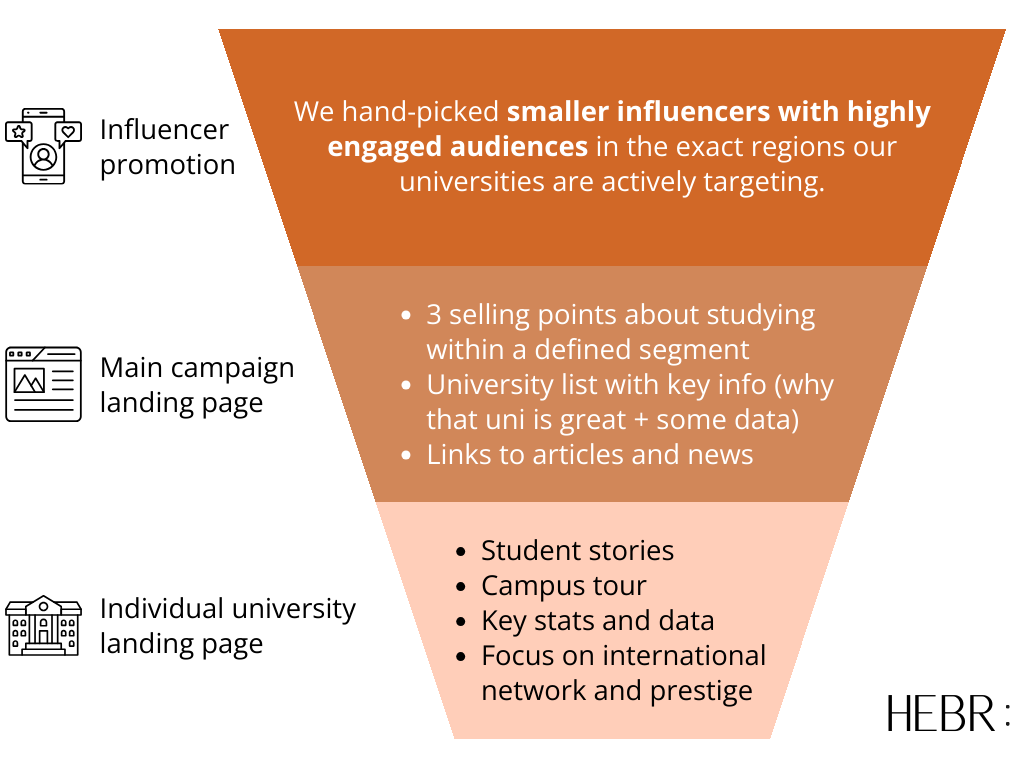
The first social proof touchpoint was external. We partnered up with hand-picked student influencers with smaller but highly engaged audiences located in geos our universities were interested in.
Then, we built the campaign landing pages, and included relevant social proof tailored to student needs at each step.
| Main campaign page (university list) | Individual university pages |
|---|---|
| Three main selling points | Student testimonails (photo + text) |
| International student ratio | Campus tour (video) |
| Global partnership network | Key facts and figures (infographic) |
Then, we combined these student stories with incentive structures to prompt students to complete lead forms for universities. We offer freebies in the form of webinars and other exclusive content.
The Results
The results so far are very promising. While I cannot disclose the exact numbers for sessions and leads, the session-to-conversion rate is 21%.
In other words, one in five students who landed on the campaign page submitted a lead.
These highlight results are also followed by excellent engagement metrics, with a healthy average bounce rate of 52% and average student staying on the page for over a minute.
| Metric | Value |
|---|---|
| Conversion rate | 21% |
| Average engagement time | 01:15 min |
| Average bounce rate | 52% |
Actionable Steps for University Leadership
If social proof now carries more weight than institutional self-description, then brand investment should move closer to the student experience itself.
As a university, you should treat student content as a core part of your brand strategy. This type of content includes, but is not limited to:
- Student ambassadors
- Alumni narratives
- Peer-to-peer Q&As
- Student-produced video content
- Student podcasts
- Graduate outcome stories
- Public student communities
Social proof works best when it is specific, current, and easy to find at the moment of decision.
Conclusion
In a market saturated with similar claims and rising skepticism toward AI-mediated information, social proof gives branding credibility. Anyone can make a claim, but not everyone can support it. Students trust students.
Institutions that organize their brand around credible student and alumni evidence will stand out more clearly, convert faster, and defend their position more effectively against competitors that still rely on polished but generic messaging.
The strongest university brand in this environment is the one where the current students can vouch for.
Sources
Lin, Chin-Lon, Wen-Long Zhuang, Hsiu-Chen Huang, Ming-Tsung Lee, and Sung-Hui Wu. “Do Satisfied Students Generate Positive Word-of-Mouth? Moderating Roles of Perceived Education Quality and University Brand Knowledge.” Humanities and Social Sciences Communications 12 (2025): 1448. https://doi.org/10.1057/s41599-025-05840-6.
Park, Sean, and Joseph McCallister. “The Effects of Social Proof Marketing Tactics on Nudging Consumer Purchase.” Journal of Student Research 12, no. 3 (2023). https://doi.org/10.47611/jsrhs.v12i3.4887
QS. From Indonesia to the World: A Report on the QS International Student Survey 2024. 2024. Accessed March 16, 2026. https://studyingreece.edu.gr/wp-content/uploads/2025/01/QS-Student-Mobility-Reports-From-Indonesia-to-the-World-2024.pdf.
Ruffalo Noel Levitz (RNL). 2024 High School Student College Planning Report: A Study of College-Bound Student Search Behaviors and Preferences. 2024. Accessed March 16, 2026. https://files.eric.ed.gov/fulltext/ED660644.pdf.
van Kessel, Gisela, Colleen Ryan, Lorraine Paras, Natalie Johnson, Razia Z. Zariff, and Helen M. Stallman. “Relationship between University Belonging and Student Outcomes: A Systematic Review and Meta-analysis.” The Australian Educational Researcher 52 (2025): 2511–2534. https://doi.org/10.1007/s13384-025-00822-8.
 Sara Evans
Leave a comment