
Executive Summary
University website navigation plays a key role in how students choose programs, but many university sites remain difficult to navigate. To address this problem, I teamed up with a developer to create a personalized program recommendation tool that combines students’ career goals with the university’s study offerings.
93% of prospective students use university websites for finding information and making an applicaton decision (RNL and Modern Campus 2023). Effective university websites are key in establishing a strong brand identity, which serves the purpose of intriguing the student to keep learning more about the university and its offerings. In this sense, university websites play an important role in the student decision-making process related to institution and program choice (Owoyele 2016).
Why Improve Program Navigation?
When choosing study programs, most students focus on the practical career benefits a university degree can provide (Keystone Education Group 2025), and only strengthened with each degree level (23% of Bachelor’s students said it was their top motivator compared to 44% of those at PhD level). In other words, students see education as a tool towards a higher-paying job and therefore a better life. In the United States, 74% of teenagers believe that one should set career goals by the end of high school, and 73% believe that a university degree is crucial for achieving those goals (ECMC Foundation 2022).
This practical approach carries with it certain risks, especially if the student does not understand a given field completely, which may lead to surprise and/or dissatisfaction with their future career. Student motivation and interest, among other key factors, play an important role in determining if the student will complete their studies or drop out (Paura and Arhipova 2014). For universities, this is a clear signal to help prospective students fully understand the opportunities they can pursue after graduation.
Prospective university students are similar to other age groups in that they prefer sleek, easy-to-navigate websites. They actively avoid.
Students Often Have Trouble Finding Programs On University Sites
Poor navigation/findability for programs and majors is one of the top prospective students’ frustrations (RNL and Modern Campus 2023).
This issue is very common as A) there is rarely a dedicated person in charge of optimizing the student experience on the site, and B) universities often use different names for menu sections (“Studies”, “Education”, “Study Excellence”, etc.). The structure of the site is usually determined by a developer, while the content added by marketers or other administrative staff, and these units often operate in silos with little to no communication. The result is usually a messy content structure that makes it hard to find and browse programs.
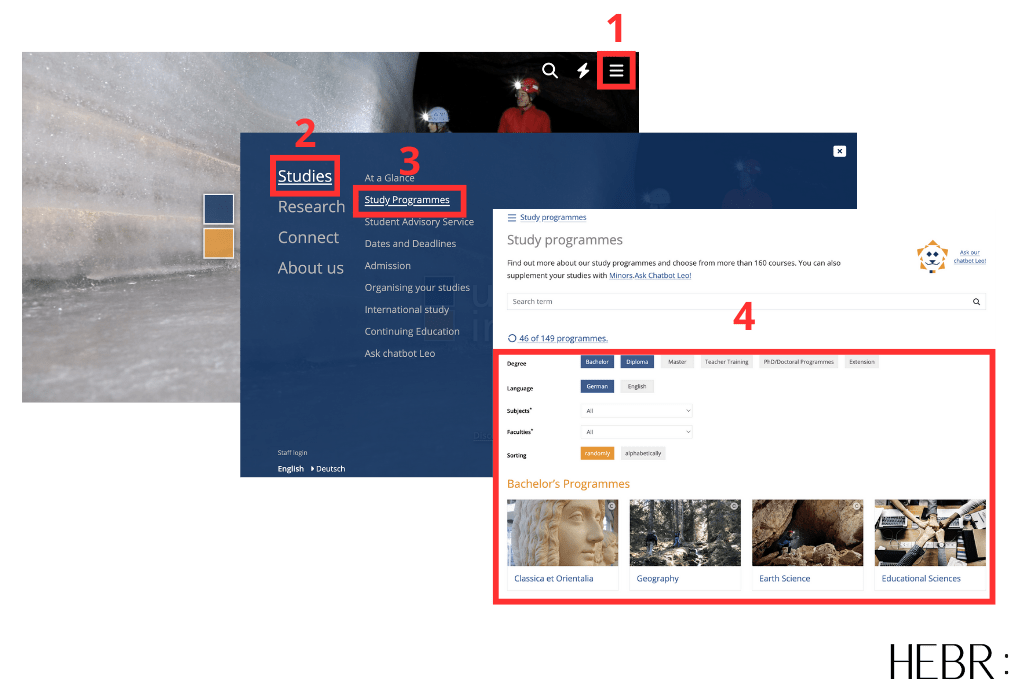
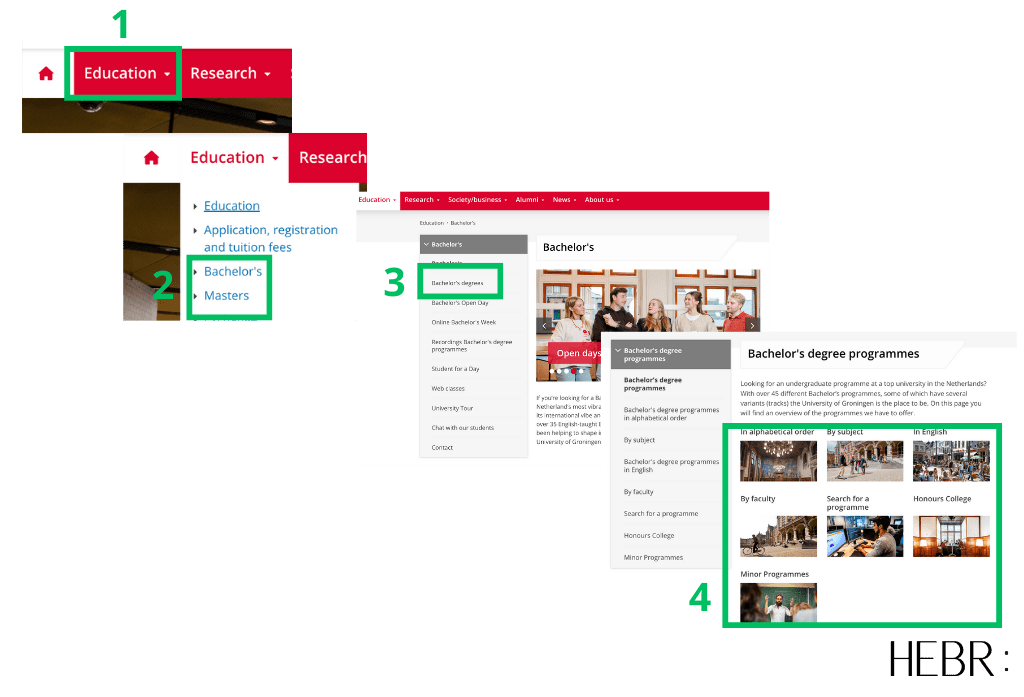
Below are two examples taken from real university websites.
University 1: the student has to click through at least 4 menus in order to reach a program listings page.
University 2: similar story as above, except there are even more buttons that could potentially confuse the student on where to find the programs listing. The shortest route to the listings page is four clicks long, but it can take as many as five or six.
Why Is Poor Navigation Experience a Problem?
The first consequence is poor user experience. Internet users are famously impatient. They avoid any complexity and bounce quickly when their expectations are not met. Providing a smooth search experience will ensure that students stay on the site long enough to get the information they need.
Second conequence is related to visibility: in other words, how (and how many) students can find your university programs. Content is the most important element for informing and converting students, but great content serves no purpose if students cannot find it. While most students will find the program information through web search, universities should not solely rely on Google to make their programs findable, as this approach carries a lot of risk. If Google changes its rankings algorithms (as it does numerously throughout the year), it may eventually make your website ranking tank, which will negatively impacts visibility if SEO is the only convenient way for students to find your programs.
Last, but not least, an inconvenient navigation structure breaks student trust. Many students choose not to pursue a degree at a university due to site navigation frustrations. I have personally spoken to students who gave up on universities in entire geographical regions due to the shared poor user experience of their sites. At best, a poor site navigation experience will be a subject of a joke (see below), and at worst, it will make students give up their search. Neither is good for the university’s brand.
Career As a Focus Point In Program Discovery
University degrees are big time and money commitments, and students want to know if this investment will be worth it. Career and job related outcomes made up 9 out of top 10 reasons why students pursued higher education (Keystone Education Group 2025). It is therefore in the university’s interest to acknowledge and meet these student needs by highlighting career outcomes like job placements and graduate employment rates in relevant places throughout the site. The good news is that many universities have recognized the importance of communicating career prospects in their program descriptions. Many programs now have a “career” section. While the information tends to be a bit dry, presented as a list of potential job titles after graduation, it is still progress. But we can always do more.
Universities who want to stand out need to embed career information within the student journey for a true personalized experience. The career should be a focal selling point, not an add-on. Further, the job advice should be customized for the unique needs and strengths of each student. However, most universities do not have the resources to spend on creating custom software for personalized recommendation. This is a challenge I aimed to solve.
Personalized Program Recommendations
I teamed up with a developer to create a software for personalized program recommendations based on the student’s educational and professional interests.
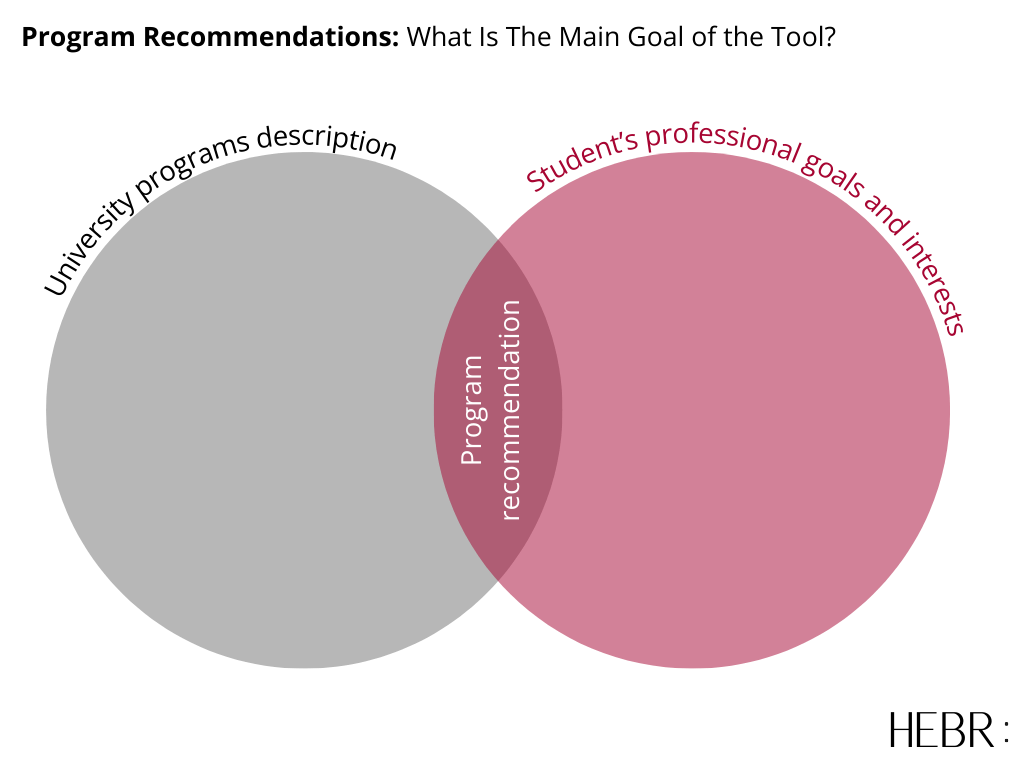
The Structure
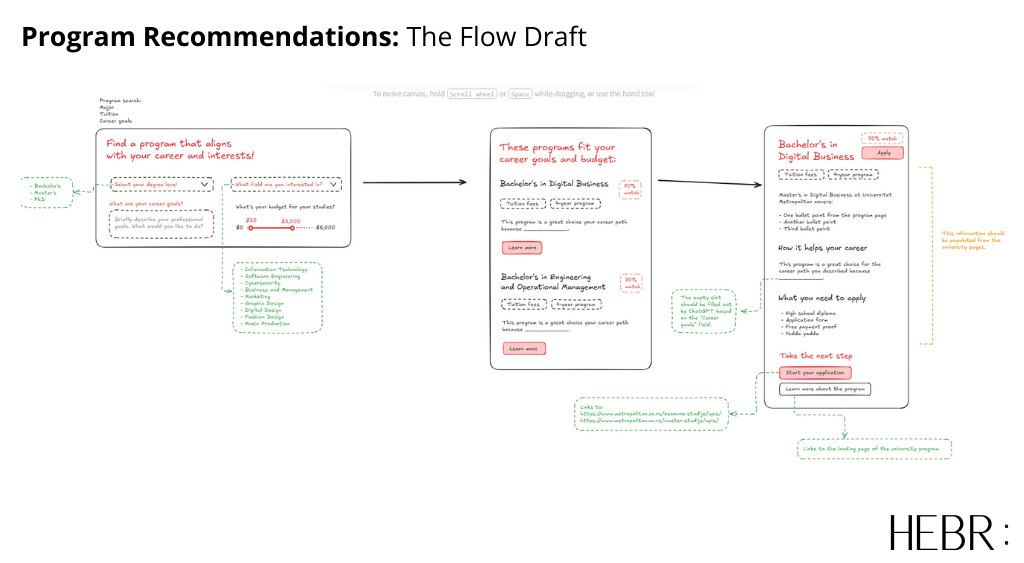
The first version of the software consists of three pages:
- The filtering tool
- The program listing page based on the filters
- The individual program page
How the Tool Works
The tool combines classic filtering options with AI to provide a personalized experience that is not difficult or expensive to maintain from a technical side. In its essence, it consists of:
- A few traditional filters (budget and subject)
- A text box where students can type in their professional goals
- A JSON database with program information
- A ChatGPT “backend” that reads the text box input and the information from the JSON file to create career suggestions
Here’s a video of the program recommendater in action:
You can preview the source code on GitHub.
Evaluating the Benefits, Limits and Future Expansion Opportunities
Key Strengths
Personalization Through AI Integration. The tool incorporates a GPT-based language model that generates recommendations based on each student’s articulated goals and interests, which represents an improvement over traditional static filtering methods.
User-Centered Experience. The development process prioritized user experience from inception. The final interface reflects established UX design principles, resulting in a system that remains clear, intuitive, and accessible. Students can navigate the tool with minimal instruction, which reduces barriers to adoption.
Current Limitations
LLM Model Capacity Constraints. The GPT-5 nano model used in this version operates with a limited context window. While adequate for prototype-scale operations with a smaller program database, this technical constraint affects the system’s ability to process extensive information within a single response. More demanding use cases will require integration of models with greater contextual capacity.
Visual Design Refinements. As typical of MVP-stage development, certain visual elements require additional polish. Visual design (beyond making the interface understandable) was not the focus of the first iteration, and is something to be improved in the future releases.
Future Expansion Roadmap
Database Expansion. The primary development priority involves expanding the program database to include multiple universities. This enhancement will substantially increase the range and relevance of recommendations, providing students with a more comprehensive view of available academic pathways.
Advanced Language Model Integration. Future iterations will incorporate more sophisticated large language models with expanded contextual processing capabilities. These upgrades will enable the system to synthesize greater volumes of student and program information, yielding more nuanced and precise recommendations.
Interface Enhancement and Feature Development. Continued refinement of the user interface will improve visual appeal and functional depth. Planned enhancements include the integration of labor market data from employment platforms relevant to the user’s geographic location, further connecting academic program recommendations with career outcome information.
Sources
ECMC Foundation. 2022. National Study Finds High Schoolers Keenly Aware of Current In-Demand Jobs, Impacting Education Choices After Graduation. May 18. Accessed January 25, 2026. http://www.ecmcfoundation.org/news/foundation/national-study-finds-high-schoolers-keenly-aware-of-current-in-demand-jobs-impacting-education-choices-after-graduation.
Keystone Education Group, State of Student Recruitment (2025), accessed January 22, 2026, https://4722110.fs1.hubspotusercontent-eu1.net/hubfs/4722110/SSR%202025%20Assets/SSR%20report%202025.pdf
Owoyele, Samson. 2016. Website as a Marketing Communication Tool. Thesis, Centria University of Applied Sciences. Accessed January 24, 2026. https://www.theseus.fi/bitstream/handle/10024/128303/OWOYELE%20SAMSON%20OLUWARANTI.pdf?sequence=1
Paura, Liga, and Irina Arhipova. “Cause Analysis of Students’ Dropout Rate in Higher Education Study Program.” Procedia – Social and Behavioral Sciences 109 (January 8, 2014): 1282–1286. https://doi.org/10.1016/j.sbspro.2013.12.625.
RNL, and Modern Campus. 2023 e-Expectations Trends Report: Attracting, Engaging and Enrolling High School Students. 2023. Accessed February 4, 2026. https://resources.moderncampus.com/2023-e-expectations-trends-report-attracting-engaging-and-enrolling-high-school-students-rnl
UPCEA. 2025. “Key Findings from 2024 UPCEA Marketing Survey.” April 17, 2025. Accessed February 1, 2026. https://upcea.edu/key-findings-from-2024-upcea-marketing-survey/.
 Sara Evans
Leave a comment