Executive Summary
With more middle and lower income families having access to higher education, the universities have had to adapt their communication strategies to measure up to the new ‘modern’ student expectations: useful knowledge, clear post-graduate pathways, affordable or flexibile schooling, and lots of support.
Universities nowadays have never been busier. In the early 1960s, only 4% of American high school graduates went to university; today, 42% of young Americans have a Bachelor’s degree or higher (Barrett 2025). With more middle and lower income families joining the ranks of graduates (UNESCO 2025), the universities have had to adapt their communication strategies to measure up to the new ‘modern’ student expectations: useful knowledge, clear post-graduate pathways, affordable or flexibile schooling, and lots of support (Mintz 2022).
Student Expectations Are Rising
The reality is, the expectations and pressure universities today face have never been higher.
An unprecedented number of students are enrolling in higher education due to their lifetime career benefits, prompting a growth in the number of programs and universities. With more universities being opened every year (Usher and Williams 2022), and with an increase in the availability of online programs (Statista 2024), the competition for acquiring students has never been steeper.
Universities are expected to provide the best education and top-of-the-line professors, for the most affordable tuition possible, while funding hundreds of events, internships, programs and exchanges to boost student engagement. Without an enormous amount of funding (which most universities do not have access to), it is unrealistic to expect all of these things to happen at the same time. Therefore, some things have to be given up.
While I cannot solve all of these complex issues universities face, I can offer a helping hand in the process of adapting your communication to match student expectations. In this article, I offer an easy approach to better understand your students: past, present, and future, which I have dubbed the “Student Needs Trifecta”.
The Student Needs Trifecta
From my experience in international student marketing, there are generally 3 broad categories of students: Optimizer, Academic and Adventurer.
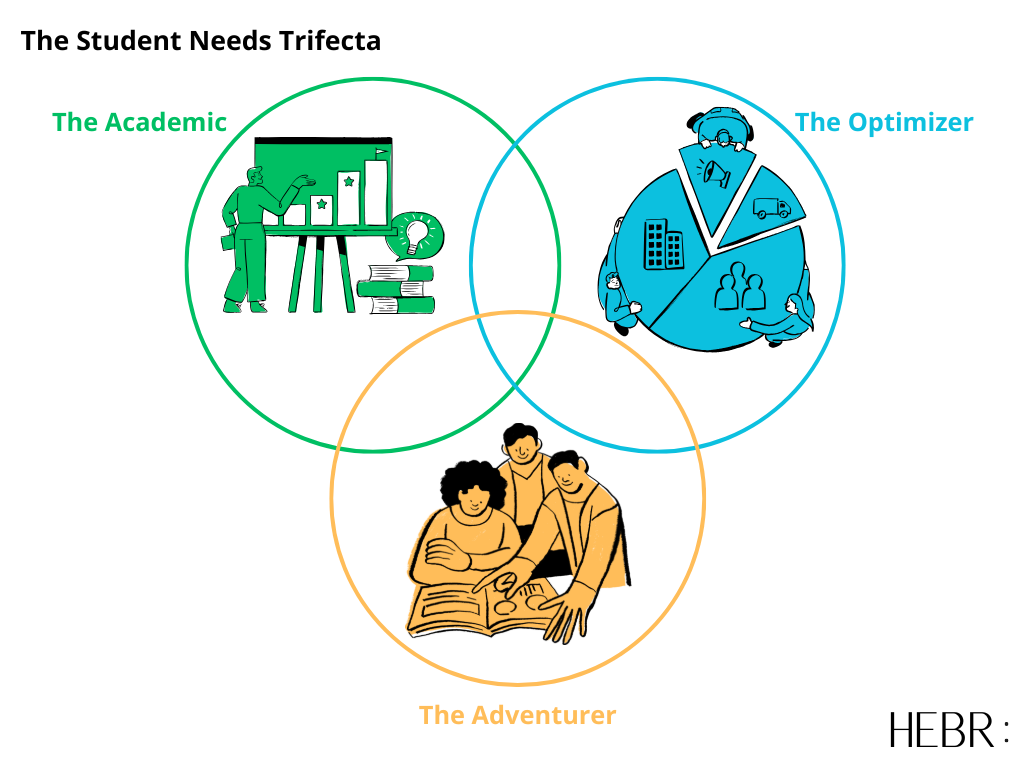
The Optimizer
Cares about:
- Funding/scholarship availability
- Internship and networking opportunities
- Graduate employment rates
- Program flexibility
Optimizers want to know exactly how education will bring tangible benefits to their career. When you want to communicate with the Optimizer, you should highlight common career paths graduates from your university take, alumni success stories, flexible study options, internship opportunities, career services and other resources your university provides to make the student experience better.
This type of student will make up the large majority of your student population (Mwantimwa 2021), as most people will look to get the best value for their money and time investment.
Ask these questions to identify the Optimizer:
- What is your goal with this degree? Is a degree a stepping stone towards an industry career in this field? Are you looking for a promotion?
- How important are scholarships or other funding sources for enrolling in a program?
- Are you currently employed? Are you looking for study options that help you balance work and study?
- What are the key deciding criteria for choosing between two similar programs?
The Academic
Cares about:
- Academic rankings
- Teaching/research staff credibility
- Institution resources
- Alumni
Some students, especially those that come from families with very high expectations, want to pursue specific universities or programs due to their prestige (in terms of academic reputation or teaching staff). If your university is widely seen as academically challenging, these students will be easier to convert.
On the other hand, if you still have some work to do in bringing up your university’s academic reputation with students, a good approach is to establish partnerships with universities that are already perceived this way. That way to you can start capturing students who are academic but also practical by associating your institution with a high reputation institution, while also offering other tangible benefits like lower costs, more flexibility, or a nicer/more convenient location.
Ask these questions to identify the Academic:
- Do you have a plan for a career in academia? Do you have a backup plan?
- Does your field and study field translate abroad?
- What is your average GPA, and what has been your average GPA? (The Academic usually have a higher-than-average GPA in their lifetime.)
- For graduate students: Have you ever published academic work, or have you researched potential academic journals for your publications?
The Adventurer
Cares about:
- Study or work abroad opportunities
- Exchange agreements with other universities
- Student community and events
- Cultural immersion
These students see university education as an opportunity for self-discovery. You will often prefer language and cultural programs, and are more likely to study niche subjects like a dialect or history of a particular region. They also look for international experiences in their programs, because they deeply value the benefit of cultural and personal enrichment that comes with living in a different country and learning a new language.
Ask these questions to identify the Adventurer:
- What made you interested in this program?
- Have you participated in any student exchange schemes?
- How many languages do you speak?
- What are your hobbies?
- Have you ever been a part of a Model UN?
Notes and discussion
It is best to think of these categories as a scale, where a student can be any mix of the three. This applies both to individual student profiles, and the total student body. So, a student profile may look something like this:

For example, students considering The Arctic University of Norway may be a combination of Academic and Adventurer. The reasoning behind this is that the university may be attracting students who are deeply interested in studying the Arctic, which the university is well-renowned for (High North News 2023), as well as intrigued by the prospect of living in the northernmost part of Europe.
The important point in using this framework is to always approach it with curiosity and critical thinking, and the goal is to have a general gist of the motivations and interests of your student body (current and future). Once you have established what your target audience looks like, you can cater your university messaging to the needs of that audience.
Sources
Barrett, Kristina. 2025. “Census Bureau Releases New Educational Attainment Data.” Press release, U.S. Census Bureau, September 3, 2025. Accessed January 6, 2026. https://www.census.gov/newsroom/press-releases/2025/educational-attainment-data.html
High North News. 2023. “The Arctic University of Norway Ranks Among the Top in Arctic Research.” High North News, November 14, 2023. https://www.highnorthnews.com/en/arctic-university-norway-ranks-among-top-arctic-research
Mintz, Steven. 2022. “What Today’s College Students Need.” Inside Higher Ed, November 16, 2022. Accessed January 6, 2026. https://www.insidehighered.com/opinion/columns/higher-ed-gamma/2022/11/16/what-todays-college-students-need
Mwantimwa, K. 2021. “What Motivates Students’ Decisions on Programmes to Pursue at University Level: The Role of Information and Knowledge.” Higher Education 82: 349–367. https://doi.org/10.1007/s10734-021-00698-4
Statista. E-Learning. PDF report. January 2024.
UNESCO. Record number of higher education students highlights global need for recognition of qualifications. June 23, 2025. Accessed January 3, 2026. https://www.unesco.org/en/articles/record-number-higher-education-students-highlights-global-need-recognition-qualifications.
Usher, Alex, and Jonathan Williams. “Higher Education Institutions Worldwide.” Higher Education Strategy Associates (HESA). March 22, 2022. Accessed January 3, 2026. https://higheredstrategy.com/higher-education-institutions-worldwide/.
 Sara Evans
Leave a comment