Executive Summary
Automated email campaigns play a critical role in university lead generation business models by nurturing potential students until they are ready to apply. I break down one of the projects where we used automations to engage prospective students with relevant content.
Automated email campaigns are emailing systems that send emails automatically based on predefined conditions. Instead of sending each email manually, the marketing team can set up a workflow where emails deploy automatically depending on certain triggers. For example, when a user subscribes to a mailing list or fills out a form, the system sends a specially created message to that user at a predetermined time. Email automation allows for better personalization
(Ovseenko and Filimonova 2025) according to user experience and needs, which leads to overall better performance metrics (Faiz and Mulla 2021).
Various studies and surveys have shown that automated approaches tend to outperform traditional marketing processes in getting users to buy a product or become more aware of the company’s brand.
Key Concepts
Lead Generation Business Model
Lead Generation (or “LeadGen” for short) is a business model that is based on identifying potential customers based on their interests or behaviors, capturing their attention and engaging them to a point of conversion. This modern is what most universities use to grow enrolments.
Online lead generation is most often in the form of a two-way digital platform that is optimized for both B2B (business-to-business) and B2C (business-to-consumer). For example, in the case of educations.com, the site I worked on, universities would pay the platform to appear in its program listings (B2B), and students would submit leads for programs and universities through the site (B2C).
Automated Email Campaigns
Automated email campaigns are created using specialized email automation software tools, which integrate with a user database. These tools track user activities (filling out forms, opening emails, registering for online events, etc.) through the database and, based on these actions, trigger appropriate email series. For example, a welcome email goes automatically to each new user in the database, while existing users do not receive these automated emails. Similarly, systems can send several consecutive emails, or the so-called “drip campaigns”, to engage users on a continuous basis.
Automation also involves content personalization: emails adjust to the recipient’s data (name, interests, user journey, etc.), making communication more relevant to each individual without requiring additional human resources to create and maintain each campaign manually, which is helpful for universities who are often operating with a limited marketing budget.
Another advantage of this approach is sustainability. The content and logic (when, why, and what the system sends) of automated campaigns only need to be created once, and the messages will deliver continuously. The marketing specialist’s role then becomes monitoring results and improving the existing system, as opposed to a narrow role of a manual executor of campaigns, which is not only a less rewarding task, but also introduces the possibility of human error.
The Role of Automated Email Campaigns In LeadGen
Automated email campaigns are key for business models based on user engagement and retention, such as the LeadGen business model. User trust and familiarity with the brand are essential for students to trust information and recommendations on platforms. At the same time, email stands out as the most effective channel for building that loyalty and trust, as it allows for direct and personalized communication (Bismo and Putra 2019). Through automated campaigns, companies can maintain constant contact with users, which contributes to higher engagement and retention rates on the platform (Kanmani, Kavitha, and Prabaharan 2025).
Automated email campaigns are also key to converting users from website visitors into customers. Most users are not ready to buy right away but rather explore different options. By systematically nurturing leads through relevant, automatically delivered content, these leads remain engaged until they are ready to buy (Hemrajani 2025). In other words, the company stays in the minds of leads through useful content, increasing the chance of conversion (Nobile and Cantoni 2023). Lead generation software automatically collects user contacts (e.g., via website forms), sends email series, and measures interaction with each campaign and its content. This ensures a constant flow of qualified leads with minimal human effort, enabling this user nurturing at scale (Belouadah 2023), which is critical for LeadGen businesses.
Hands-On Implementation of Automations in University Promotional Campaigns
While I cannot share all of the details of the A/B testing and projects we have done while working on university client campaigns due to NDA restrictions, I would like to share some high-level overviews of some of the projects I led while overseeing the educations.com’s email marketing strategy.
Standard Email Campaigns
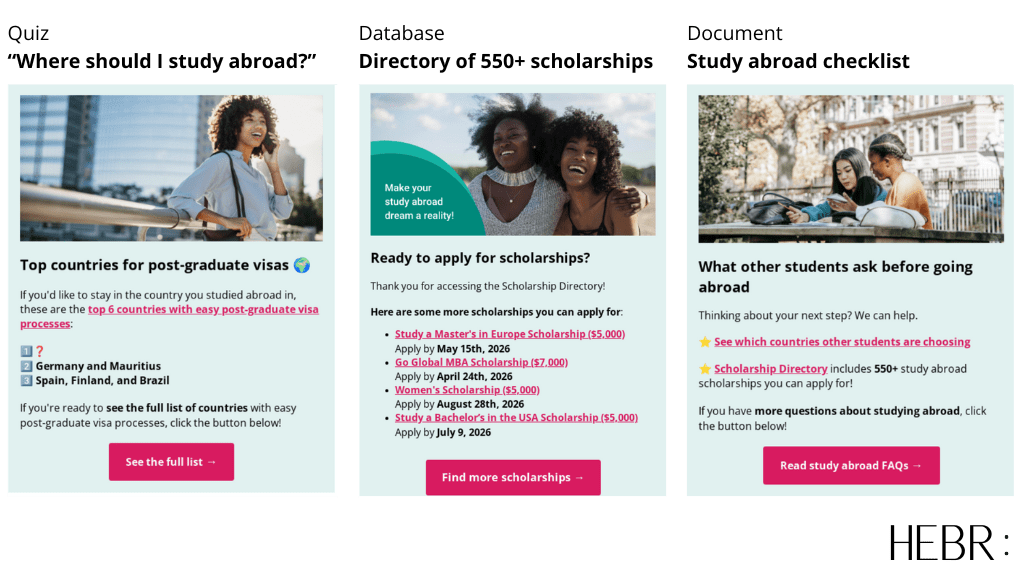
I was in charge of setting up the company’s automation campaigns from scratch. We ended up creating 24 “standard” automated email campaigns for students coming into our database through editorial content. These were generally simple automations that which were designed to:
- Filter out spam users or misspelled email addresses
- Segment new users based on their “entry point” into the database (quiz, downloadable, etc.)

The content of each personalized email is key to maintaining user interest. So, the content decisions and the approach we followed depended directly on the user intent at the trigger point. For example, someone who filled out a form to receive a university motivation letter template has different needs than someone who completed a quiz on study methods. Therefore, the campaign messaging differed significantly depending on the need and interest.
The main questions we asked in the campaign creation process were:
- What does the student want to achieve?
- What information does the student need to make a decision?
- What is their next step?
- Do we have relevant content that could help the student?
- Is the tone appropriate for the situation?
- What is the age or maturity level of this student?
- What are their concerns or problems? Can we address them?
Scholarship Email Campaigns
educations.com offers several scholarships every year to help students pay for their studies. The scholarship application process consists of two forms due to certain technical limitations in integration between different platforms the company uses. This limitation adds complexity both for students and scholarship reviewers. So, the email automations actually provide several benefits in this case:
- The automated email provides an immediate notification that the application has been registered.
- The student receives instant feedback on the application: the system automatically filters out ineligible applicants and guides eligible ones to the next step. This helps reduce manual work for reviewers.
- Students are encouraged to stay in the email database for future scholarship recommendations.
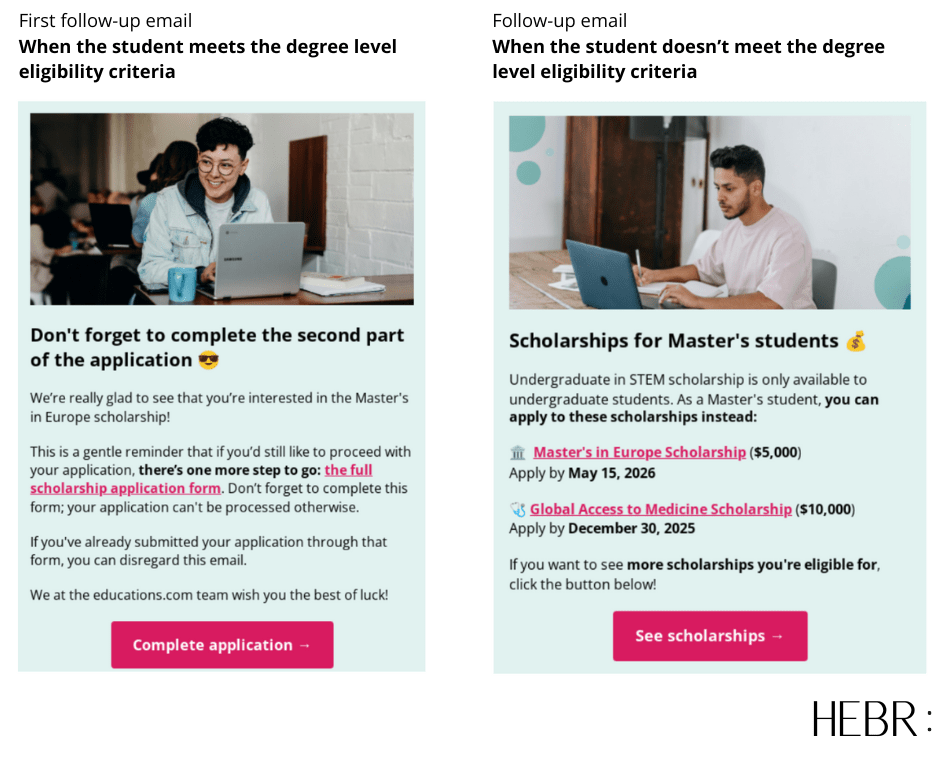
Here is the sketch of the “logic” that we used to connect these forms with the goal of simplifying the process and giving immediate feedback to students where needed.

The first automated email campaign is sent immediately after the student completes the first form.
- If the student meets the scholarship application criteria, they will receive an email with a reminder to fill out the main form.
- If the student does not meet the scholarship criteria, they will receive an email explaining that the level of study is not valid for the scholarship they applied for, along with a list of other scholarships for which they qualify.
The second campaign is sent two weeks later to students who have successfully completed the application. In this email, the email will suggest a few other scholarships that the student can apply for while waiting on the first scholarship winner announcement.
Results
Below is a table summarizing the average results from the 32 campaigns we created in comparison to industry standard* figures, which were taken from Klaviyo’s reference values for automated email campaigns in 2024.
| Average results (industry standard*) | Exceptional results (industry standard*) | Average results from our automatic emails | |
|---|---|---|---|
| Open rate | 48% | 66% | 67% |
| Click-to-open rate | 5% | 12% | 39% |
What is more, the conversion rate for these automatic emails is 38%, meaning that just over one in three people who clicked through the email submitted a lead for a program or university. This indicates high user intent and engagement with the content.
Another benefit of automated campaigns is that they provide a continuous system for getting users back to the site or app, which boosts the overall number of conversion opportunities. A good illustration is the figure below, which shows how much different traffic sources contribute to the total session numbers. The details of each source are obfuscated for NDA compliance reasons, but the important element for this discussion is the blue section, which represents how much emails contribute to traffic. The automated campaigns were created in June, and by September, the amount of sessions brought in via emails tripled.

Discussion
The results show that automated campaigns achieve high open and click rates, especially for scholarship applications. The majority of campaigns exceed industry benchmarks. In our data, individual scholarship campaigns have open rates of 74 to 83% and click rates of up to 46%, indicating a high level of student engagement and good alignment of messages with user expectations.
Standard and scholarship campaigns differ by a few percentage points, which makes sense. Scholarships attract students with a clear goal and offer a strong monetary incentive to engage, which addresses a key student paint point: how to finance their study abroad (Keystone Education Group 2025). Therefore, messages that remind students to complete their scholarship application or offer similar scholarships respond to the needs and interests of students at that moment. On the other hand, standard campaigns have a broader audience and no monetary incentive, and therefore the results are more varied. However, they also have relatively stable engagement rates, especially when the messages link to a question or need that the student has at the moment of the entry point.
An important contribution of automated emails is also maintaining the quality of the database. The standard algorithm systematically filters out duplicates and invalid addresses and only then sends messages. This reduces the risk of oversending and preserves the reputation of the domain.
Sources
Belouadah, Amina. 2023. The Impact of Marketing Automation on Enhancing Personalized Messaging Strategies. Poslednji pristup August 24, 2025. http://www.theseus.fi/bitstream/handle/10024/814353/Belouadah_Amina.pdf?sequence=2.
Bismo, Aryo, i Sukma Putra. 2019. „Application of Digital Marketing (social media and email marketing) and its Impact on Customer Engagement in Purchase Intention: a case study at PT. Soltius Indonesia.“ 2019 International Conference on Information Management and Technology (ICIMTech). IEEE.
Faiz, Mohiuddin, and Faiz Mulla. 2021. “Optimizing Customer Retention Through Data-Driven Email Marketing Strategies.” International Journal of Scientific Research in Engineering and Management 5. https://doi.org/10.55041/IJSREM8895.
Hemrajani, Dhruv. 2025. „Optimizing Customer Engagement: A Comprehensive Analysis of Email Marketing Strategies.“ Authorea. Poslednji pristup August 23, 2025. http://www.authorea.com/doi/full/10.22541/au.174129489.92078184.
Kanmani, J, M Kavitha, i T Prabaharan. 2025. „Influence Of Marketing Automation on Customer Retention.“ Journal of Neonatal Surgery 14 (12): 997-1001.
Keystone Education Group. 2025. “State of Student Recruitment Report 2025.” http://www.4722110.fs1.hubspotusercontent-eu1.net/hubfs/4722110/SSR%202025%20Assets/SSR%20report%202025.pdf
Muzellec, Laurent, Sébastien Ronteau, i Mary Lambkin. 2015. „Two-sided Internet platforms: A business model lifecycle perspective.“ Industrial Marketing Management 45: 139-150.
Nobile, Tekila Harley, i Lorenzo Cantoni. 2023. „Personalisation (In)effectiveness in email marketing.“ Digital Business (Elsevier) 3 (2).
Ovseenko, Galina, and Tamara Filimonova. “Email Automation for Marketing Campaigns: Comparative Analysis and Software Development.” Ekonomika i Upravlenie: Problemy, Resheniya 5, no. 11 (2025): 4–10. https://doi.org/10.36871/ek.up.p.r.2025.05.11.001.
 Sara Evans